Source Code
<section class="rkt-stage" id="rktStage">
  <div class="rkt-intro"><p>Scroll ↓ to launch</p></div>
  <canvas id="rktCanvas"></canvas>
  <div class="rkt-hud">ALT <span id="rktAlt">0.0</span> KM · <span id="rktPhase">PRE-LAUNCH</span></div>
</section>
<section class="rkt-bottom"><p>Orbit insertion nominal.</p></section>*{box-sizing:border-box;margin:0;padding:0}
html,body{background:#0a1120;color:#fff;font-family:system-ui,-apple-system,sans-serif}
.rkt-bottom{min-height:70vh;display:flex;justify-content:center;align-items:center;color:#7f93b8;font-size:15px;letter-spacing:.08em;text-transform:uppercase;background:#02040c}
.rkt-stage{height:100vh;position:relative;overflow:hidden;background:#0a1120}
.rkt-intro{position:absolute;inset:0;display:flex;align-items:center;justify-content:center;text-align:center;padding:24px;pointer-events:none;z-index:5;color:#cfe0ff;font-size:15px;letter-spacing:.08em;text-transform:uppercase;transition:opacity .4s ease}
#rktCanvas{display:block;width:100%;height:100%}
.rkt-hud{position:absolute;left:24px;bottom:24px;font-variant-numeric:tabular-nums;font-size:13px;letter-spacing:.14em;color:#fb923c;text-transform:uppercase;opacity:.85}const canvas = document.getElementById('rktCanvas');
const altEl = document.getElementById('rktAlt');
const phaseEl = document.getElementById('rktPhase');
const introEl = document.querySelector('.rkt-intro');
const renderer = new THREE.WebGLRenderer({ canvas, antialias: true });
renderer.setPixelRatio(Math.min(window.devicePixelRatio, 2));
const scene = new THREE.Scene();
// Sky gradient handled by scroll: dawn blue → deep space.
const SKY0 = new THREE.Color(0x2a4a7a), SKY1 = new THREE.Color(0x01020a);
scene.background = SKY0.clone();
scene.fog = new THREE.Fog(0x2a4a7a, 60, 220);
const camera = new THREE.PerspectiveCamera(55, 1, 0.1, 600);
scene.add(new THREE.AmbientLight(0xffffff, 0.5));
const sun = new THREE.DirectionalLight(0xffe8c8, 1.1);
sun.position.set(-40, 30, 30);
scene.add(sun);
const engineGlow = new THREE.PointLight(0xff9a3c, 0, 40);
scene.add(engineGlow);
// Launch pad ground + tower, left behind as the rocket climbs.
const ground = new THREE.Mesh(
new THREE.CylinderGeometry(80, 80, 2, 48),
new THREE.MeshLambertMaterial({ color: 0x24354f })
);
ground.position.y = -1;
scene.add(ground);
const tower = new THREE.Mesh(
new THREE.BoxGeometry(2, 26, 2),
new THREE.MeshLambertMaterial({ color: 0x374b66 })
);
tower.position.set(6, 13, 0);
scene.add(tower);
// The rocket: booster stage + upper stage + capsule + fins, grouped so
// stage separation can split the hierarchy mid-flight.
const rocket = new THREE.Group();
scene.add(rocket);
const white = new THREE.MeshStandardMaterial({ color: 0xe8ecf2, roughness: 0.4, metalness: 0.3 });
const dark = new THREE.MeshStandardMaterial({ color: 0x1f2937, roughness: 0.5, metalness: 0.5 });
const booster = new THREE.Group();
const boosterBody = new THREE.Mesh(new THREE.CylinderGeometry(1.5, 1.5, 12, 24), white);
boosterBody.position.y = 6;
booster.add(boosterBody);
for (let i = 0; i < 4; i++) {
const fin = new THREE.Mesh(new THREE.BoxGeometry(0.18, 3.4, 2.2), dark);
const a = (i / 4) * Math.PI * 2;
fin.position.set(Math.cos(a) * 1.9, 1.6, Math.sin(a) * 1.9);
fin.rotation.y = -a;
booster.add(fin);
}
const nozzle = new THREE.Mesh(new THREE.CylinderGeometry(0.9, 1.25, 1.4, 24), dark);
nozzle.position.y = -0.6;
booster.add(nozzle);
rocket.add(booster);
const upper = new THREE.Group();
const upperBody = new THREE.Mesh(new THREE.CylinderGeometry(1.5, 1.5, 5.5, 24), white);
upperBody.position.y = 14.75;
upper.add(upperBody);
const capsule = new THREE.Mesh(new THREE.ConeGeometry(1.5, 3.2, 24), dark);
capsule.position.y = 19.1;
upper.add(capsule);
rocket.add(upper);
// Exhaust: recycled particles pushed down from the active nozzle; their
// spawn rate scales with thrust so the plume dies at MECO.
const EX = 500;
const exGeo = new THREE.BufferGeometry();
const exPos = new Float32Array(EX * 3);
const exLife = new Float32Array(EX);
for (let i = 0; i < EX; i++) { exLife[i] = Math.random(); exPos[i * 3 + 1] = -9999; }
exGeo.setAttribute('position', new THREE.BufferAttribute(exPos, 3));
const exhaust = new THREE.Points(exGeo, new THREE.PointsMaterial({
color: 0xffb35c, size: 0.85, transparent: true, opacity: 0.9,
blending: THREE.AdditiveBlending, depthWrite: false,
}));
scene.add(exhaust);
// Stars fade in as the sky darkens.
const starGeo = new THREE.BufferGeometry();
const starPos = new Float32Array(900 * 3);
for (let i = 0; i < 900; i++) {
starPos[i * 3] = (Math.random() - 0.5) * 500;
starPos[i * 3 + 1] = 60 + Math.random() * 400;
starPos[i * 3 + 2] = (Math.random() - 0.5) * 500;
}
starGeo.setAttribute('position', new THREE.BufferAttribute(starPos, 3));
const stars = new THREE.Points(starGeo, new THREE.PointsMaterial({
color: 0xdde6ff, size: 0.9, transparent: true, opacity: 0, sizeAttenuation: true,
}));
scene.add(stars);
gsap.registerPlugin(ScrollTrigger);
const flight = { p: 0 };
gsap.to(flight, {
p: 1,
ease: 'none',
scrollTrigger: { trigger: '#rktStage', start: 'top top', end: '+=500%', scrub: 0.5, pin: true },
});
function resize() {
const w = canvas.clientWidth, h = canvas.clientHeight;
renderer.setSize(w, h, false);
camera.aspect = w / h;
camera.updateProjectionMatrix();
}
// Flight profile phases (fractions of scroll):
// 0–0.08 ignition rumble · 0.08–0.55 boost · 0.55–0.62 separation
// 0.62–1 upper-stage climb to orbit.
const SEP = 0.58;
const clock = new THREE.Clock();
const skyTmp = new THREE.Color();
function animate() {
requestAnimationFrame(animate);
const t = clock.getElapsedTime();
const p = flight.p;
if (introEl) introEl.style.opacity = p > 0.02 ? '0' : '1';
// Altitude: quadratic in p so the climb accelerates like a real ascent.
const alt = Math.max(0, (p - 0.08) / 0.92);
const y = alt * alt * 190;
rocket.position.y = y;
// Ignition rumble before liftoff.
const rumble = (p > 0.02 && p < 0.1) ? Math.sin(t * 60) * 0.06 * ((p - 0.02) / 0.08) : 0;
rocket.position.x = rumble;
// Stage separation: after SEP the booster stops tracking the rocket
// group's climb and falls away with tumble.
const sep = Math.max(0, (p - SEP) / (1 - SEP));
if (sep > 0) {
booster.position.y = -sep * sep * 150;
booster.position.x = -sep * 22;
booster.rotation.z = sep * 1.8;
} else {
booster.position.set(0, 0, 0);
booster.rotation.z = 0;
}
// Thrust: full during boost, brief gap at separation, upper stage relights.
const thrust = p < 0.06 ? 0 : (p < SEP ? 1 : (p < SEP + 0.05 ? 0.1 : 0.75));
engineGlow.intensity = thrust * (2.2 + Math.sin(t * 40) * 0.5);
// The active nozzle: booster bottom before sep, upper stage bottom after.
const nozzleY = p < SEP ? y - 0.6 : y + 12 - 0.5;
engineGlow.position.set(rumble, nozzleY - 1.5, 0);
const ep = exhaust.geometry.attributes.position;
for (let i = 0; i < EX; i++) {
exLife[i] += 0.025 + (i % 7) * 0.004;
if (exLife[i] > 1) {
exLife[i] = 0;
if (thrust > 0.15) {
ep.array[i * 3] = rumble + (Math.random() - 0.5) * 0.7;
ep.array[i * 3 + 1] = nozzleY;
ep.array[i * 3 + 2] = (Math.random() - 0.5) * 0.7;
} else {
ep.array[i * 3 + 1] = -9999;
}
} else if (ep.array[i * 3 + 1] > -999) {
ep.array[i * 3 + 1] -= 1.1 + exLife[i] * 1.6;
ep.array[i * 3] += (Math.random() - 0.5) * 0.3;
ep.array[i * 3 + 2] += (Math.random() - 0.5) * 0.3;
}
}
ep.needsUpdate = true;
exhaust.material.opacity = 0.25 + thrust * 0.65;
// Sky darkens with altitude; stars and fog respond in lockstep.
const dark01 = Math.min(1, y / 130);
skyTmp.copy(SKY0).lerp(SKY1, dark01);
scene.background.copy(skyTmp);
scene.fog.color.copy(skyTmp);
stars.material.opacity = Math.max(0, dark01 - 0.35) * 1.4;
// Chase camera: below-looking-up at the pad, pulling alongside in
// flight, settling behind the upper stage near orbit.
const camY = 6 + y * 0.96 + dark01 * 6;
const camDist = 26 - Math.min(1, p * 2) * 6 + dark01 * 8;
const ang = 0.5 + p * 1.1;
camera.position.set(Math.sin(ang) * camDist, camY, Math.cos(ang) * camDist);
camera.lookAt(rumble, y + (p < SEP ? 8 : 15), 0);
altEl.textContent = (y * 0.55).toFixed(1);
phaseEl.textContent = p < 0.08 ? 'PRE-LAUNCH' : (p < SEP ? 'BOOST' : (p < SEP + 0.05 ? 'STAGE SEP' : 'ORBIT BURN'));
renderer.render(scene, camera);
}
resize();
window.addEventListener('resize', resize);
animate();Learn Coding Visually
Learn to code with interactive, live-preview playgrounds — HTML, CSS, JavaScript, React & more.
 HTML Playground42 lessons · Click-based · Live preview
 CSS PlaygroundLearn CSS with a live editor
 JavaScript Playground60 lessons · DOM · Async · Canvas
 React PlaygroundLearn React with a live code editor
 GSAP PlaygroundLearn GSAP animation interactively
 SVG Playground44 lessons · shapes · paths · animation
 SCSS Playground45 lessons · Sass modules · tokens
 Tailwind PlaygroundLearn Tailwind CSS with a live editor
 Bootstrap 5 Playground50 lessons · live preview
Three.js Scroll Rocket Launch — Stage Separation Scrub
Three.js Scroll Rocket Launch Sequence · Scroll · Plain HTML, CSS & JS · Live preview
What's included
Features
About this UI Snippet
How to Build a Scroll-Driven Rocket Launch With Stage Separation in Three.js
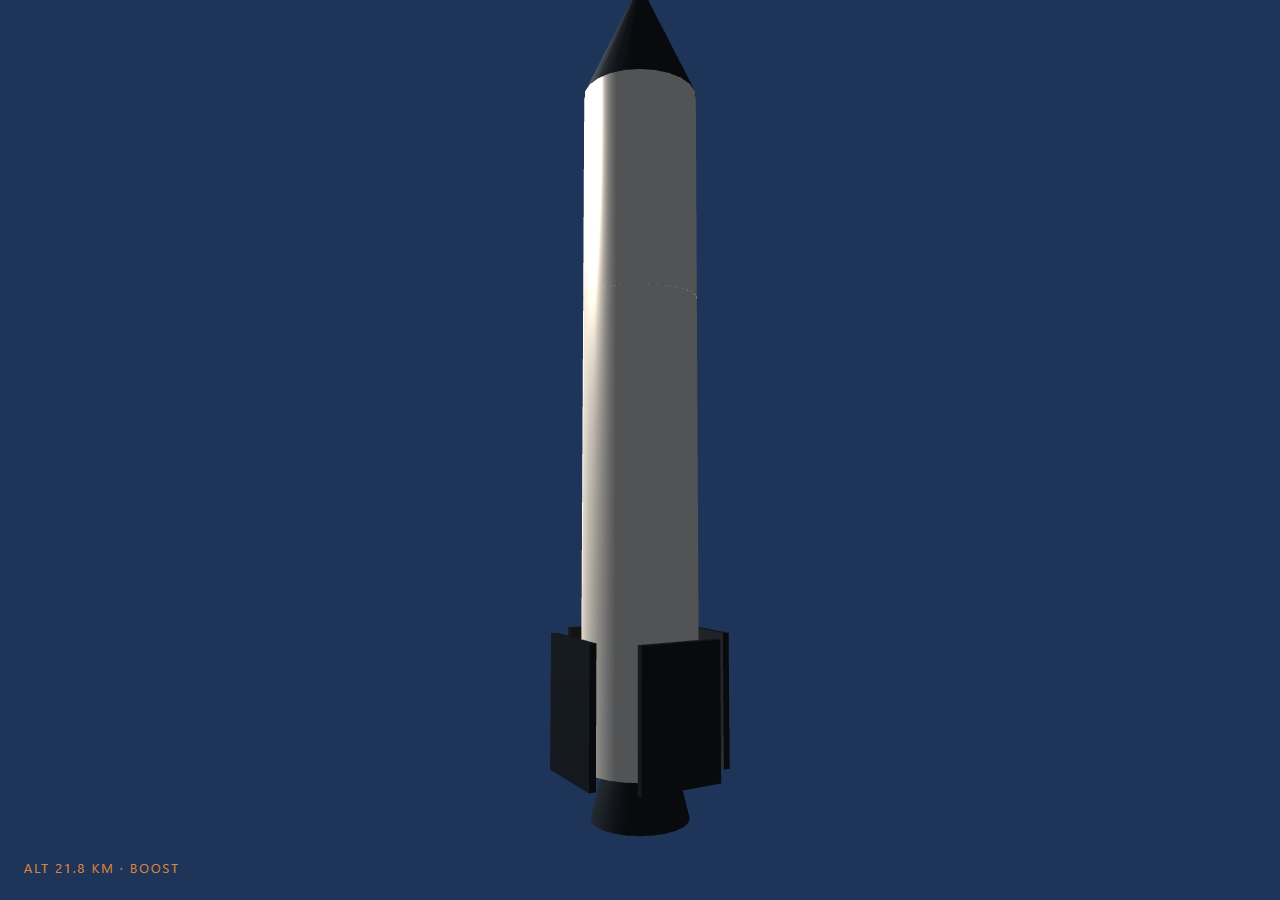
The Three.js Scroll Rocket Launch Sequence snippet flies a two-stage rocket from a rumbling launch pad to orbit in one scroll: ignition shake, an accelerating boost climb, booster separation with a tumbling fall-away, an upper-stage relight, and a sky that darkens from dawn blue to starfield black as altitude accrues. GSAP's ScrollTrigger scrubs one flight value; a phase table carves it into the mission timeline.
A mission profile, not an animation timeline
The scroll is divided the way real launches are: pre-launch below 8%, boost to 58%, a five-point separation window, then the orbit burn. Each frame classifies the scrubbed value against these fractions and derives phase-specific behavior — rumble amplitude, thrust level, which nozzle emits, HUD phase text. Because classification happens per frame from one value (rather than chained tweens firing), scrubbing backwards flies the mission in reverse: the booster re-attaches, the sky re-lightens, the rumble returns. The quadratic altitude curve alt² × 190 makes the climb accelerate like a vehicle burning off mass, opposite to the braking curve of the planet approach.
Stage separation via group hierarchy
The rocket is a Group containing two child groups — booster and upper stage. Before separation both inherit the parent's climb; after it, the booster's *local* position and rotation animate away (falling on its own quadratic, drifting sideways, tumbling 1.8 radians) while the parent group keeps climbing with the upper stage. No re-parenting, no world-matrix surgery: the separation is two local transforms diverging inside one hierarchy, the same leverage the exploded view uses for its chips.
Exhaust with lifetimes, gated by thrust
The plume is 500 recycled particles, each with a life value that wraps at 1. On rebirth, a particle respawns at the *currently active* nozzle — booster bottom before separation, upper-stage bottom after — but only if thrust exceeds 0.15; otherwise it parks at y = −9999. This spawn-gating means the plume naturally dies during the separation coast and re-ignites for the orbit burn, with no particle-system on/off switch: the thrust scalar is the only control. A flickering point light at the nozzle (intensity thrust × (2.2 + sin(40t) × 0.5)) lights nearby geometry with engine glow.
Sky-to-space is one lerp driving three systems
Altitude normalizes into a darkness value that simultaneously lerps the background color, re-colors the fog to match (the halo-avoidance rule from the ocean dive), and fades in a 900-point starfield that only becomes visible past 35% darkness. One derived scalar keeps the three systems in perfect sync — no way for stars to appear in a blue sky.
A chase camera with phase awareness
The camera reads like launch coverage: low and looking up at the pad, pulling alongside during boost (its Y tracks 96% of rocket altitude so the vehicle slowly outruns it), then drifting wider and higher as space arrives. Its look-at target switches from the booster's midsection to the upper stage after separation, keeping the active vehicle framed while the spent booster tumbles out of shot. The ignition rumble is a 60 Hz sine on the rocket's X position, amplitude-enveloped by the pre-launch window — a cheap, effective shake that also feeds the exhaust spawn origin. For the descent-flavored sibling of this scene, see the staircase climb; for city-scale flyover framing, the city flyover.
Build with AI
Build, Understand, Optimize, and Extend It With AI
You do not need to storyboard a launch from scratch — the mission profile is already a phase table you can edit. Paste this snippet's HTML, CSS, and JS into an AI assistant like Claude and ask it to explain the group-hierarchy separation trick, the thrust-gated particle respawn, or the single darkness scalar syncing sky, fog, and stars. The same assistant can extend the mission — a launch tower that retracts its arm at ignition, a max-Q condensation ring at a set altitude, fairing halves that jettison after separation using the same local-divergence pattern, a second booster for a side-core configuration, or a countdown overlay that ticks with early scroll. It can also re-tune the phase fractions so separation lands exactly on your page's key message. Treat the code as a starting point to interrogate and reshape, not a finished artifact.
Prompt to recreate it
Copy this into your AI assistant of choice to build the effect from scratch, or as a jumping-off point for your own variant:
Build a "scroll-driven two-stage rocket launch" in plain HTML, CSS, and JavaScript using Three.js and GSAP's ScrollTrigger plugin, all loaded from a CDN (no bundler, no build step).

Requirements:
- A pinned full-viewport section with a canvas, WebGLRenderer, PerspectiveCamera (resized with aspect on window resize), ambient + warm directional light, a wide ground cylinder, and a launch tower box beside the pad.
- A rocket as a Group containing TWO child groups: a booster (cylinder body, 4 fins, nozzle) and an upper stage (cylinder + cone capsule). White MeshStandardMaterial bodies with dark accents.
- One GSAP tween (ease "none") scrubbing p 0→1 on a ScrollTrigger with pin: true, scrub ~0.5, end ~+=500%.
- A mission phase table applied per frame: pre-launch below 0.08 (60 Hz X-rumble with a ramp-in envelope), boost to SEP = 0.58, a 0.05-wide separation coast, then orbit burn. Derive thrust per phase: 0 → 1 → 0.1 → 0.75.
- Altitude = ((p − 0.08) / 0.92)² × 190 clamped at 0, applied to the rocket group — an ACCELERATING climb.
- Stage separation WITHOUT re-parenting: after SEP the booster's LOCAL transform diverges (its own downward quadratic, sideways drift, ~1.8 rad tumble) while the parent group keeps climbing with the upper stage; before SEP its local transform resets to identity so reverse scroll re-attaches it.
- Exhaust: 500 particles with wrapping lifetimes; on wrap, respawn at the ACTIVE nozzle (booster bottom before SEP, upper-stage bottom after) only when thrust > 0.15, else park at y = −9999. Additive blending, plus a flickering PointLight at the nozzle scaled by thrust.
- One darkness scalar dark01 = min(1, altitude/130) lerping the sky background dawn-blue → black, copying the same color into the fog, and fading in a 900-point starfield only past 0.35.
- A chase camera: low and looking up pre-launch, tracking ~96% of altitude alongside during boost, widening in space; its lookAt target switches from booster midsection to upper stage at SEP.
- A HUD with live altitude (scaled to km) and phase name (PRE-LAUNCH / BOOST / STAGE SEP / ORBIT BURN); intro overlay fades at p > 0.02.
- Confirm reverse scrolling flies the mission backwards, booster re-attaching and sky re-lightening.
Want to tighten it up first? Run this prompt through the AI Prompt Studio to score it across 8 quality dimensions, catch anti-patterns, and tune the wording for Claude, ChatGPT, or Gemini before you paste it in.
Step by step
How to Use
- 1Load the three CDN scriptsAdd three.min.js, gsap.min.js, and ScrollTrigger.min.js in that order before the snippet JS.
- 2Paste HTML, CSS, and JSA white two-stage rocket stands beside its tower under a dawn sky, HUD reading ALT 0.0 KM · PRE-LAUNCH.
- 3Scroll to igniteThe vehicle shakes with a 60 Hz rumble, the plume lights, and liftoff begins — altitude climbing on an accelerating curve.
- 4Watch separation at 58%The booster tumbles away trailing nothing while the upper stage coasts briefly, then relights for the orbit burn.
- 5Reach orbitThe sky completes its fade to black, stars at full strength, HUD reading ORBIT BURN as the camera settles wide.
- 6Re-profile the missionAdjust SEP and the phase fractions, the alt² × 190 climb curve, or the thrust table to fly a different vehicle.
Real-world uses
Common Use Cases
Got questions?
Frequently Asked Questions
The rocket Group contains booster and upper-stage child groups. Both inherit the parent's climb, so before separation their local transforms are identity. After p crosses SEP, the booster's LOCAL position and rotation animate away — falling on its own quadratic, drifting sideways, tumbling — while the parent keeps rising. World position = parent climb + local divergence, so the fall-away is automatic and perfectly reversible when scrolling back.
Each particle has a lifetime that wraps at 1. On wrap it respawns at the active nozzle only if the thrust scalar exceeds 0.15; otherwise it parks off-screen at y = −9999. Thrust is derived per frame from the phase table (1 during boost, 0.1 during the separation coast, 0.75 for the orbit burn), so the plume dies and relights purely as a consequence of thrust — there is no explicit particle-system toggle anywhere.
All three consume one derived scalar: dark01 = min(1, altitude / 130). The background lerps dawn-blue to space-black by it, the fog color copies the same lerped color (so distant geometry dissolves correctly at every altitude), and star opacity is max(0, dark01 − 0.35) × 1.4, keeping stars invisible until the sky is ~35% dark. One input, three outputs — desynchronization is structurally impossible.
A 60 Hz sine on the rocket's X position — sin(t × 60) × 0.06 — multiplied by an envelope that ramps in across the 2%–10% scroll window and is zero elsewhere. The exhaust spawn origin and engine light follow the same offset, so the whole vehicle-plus-plume assembly shakes as one. It reads as engines straining against hold-downs at a cost of one line.
Yes. Export via the JSX, Vue, Angular, or Tailwind buttons. Build the rocket hierarchy, particles, and ScrollTrigger in a mount effect against a canvas ref; update the two HUD spans through refs since they change per frame. On cleanup kill the ScrollTrigger, dispose all geometries and materials (booster, upper stage, exhaust, stars, ground, tower), and call renderer.dispose().